When I started posting up tunes on a Friday I thought I'd be going through my back catalogue fairly quickly. Fortunately there are a lot of great local bands still producing fantastic music and so, powered mainly by the might of 4ZZZ, I'm finding a lot of new stuff to put up too. Here's one that's a little darker than the recent offerings - Occults with 'Sex & Death'. Got to love that old-school Goth sound...
Thursday, August 22, 2013

Droning On
I've been playing around with the drone when I can over the last few weeks. Unfortunately it needs relatively windless conditions and a reasonable level of light to work, and it's hard to find that when I'm in the office most days and the infamous Ekka Westerlies are blowing.
Flying the drone always felt a bit odd but I couldn't figure out why. It all clicked into place when I read a post online that pointed out that you're not controlling the individual components of the drone like you are with a model plane. You're not increasing the throttle or tilting an aerilon - instead you're using the application that you have on your android device to tell the drone what you want it to do, and it then does its best to carry out that action. You don't increase the throttle to make it move faster, you tell it to move faster in a certain direction and the various bits of computing power make the adjustments to tilt and propeller speed to accelerate it. This is why it's so intuitive, but also why it can be weird if you're used to breaking down these things into individual components.
It also means that you can download and use different apps to fly the same device. Here's me trying to figure out a new app, as taken from the drone. Ah - so that's the camera button
 '
'


Unfortunately recorded video is still jerky and hard to watch as I'm not very smooth in my movements. If you fly the drone at speed and then tell it to stop suddenly it needs to tilt backwards to make that stop, so I'm slowly learning to decelerate it in a way that doesn't leave the viewer feeling seasick. I'm getting there though and still aim to chase mountain bikers through the woods. I just don't want to be this guy...
Don't think I'll be doing any wedding shoots any time soon....
Flying the drone always felt a bit odd but I couldn't figure out why. It all clicked into place when I read a post online that pointed out that you're not controlling the individual components of the drone like you are with a model plane. You're not increasing the throttle or tilting an aerilon - instead you're using the application that you have on your android device to tell the drone what you want it to do, and it then does its best to carry out that action. You don't increase the throttle to make it move faster, you tell it to move faster in a certain direction and the various bits of computing power make the adjustments to tilt and propeller speed to accelerate it. This is why it's so intuitive, but also why it can be weird if you're used to breaking down these things into individual components.
It also means that you can download and use different apps to fly the same device. Here's me trying to figure out a new app, as taken from the drone. Ah - so that's the camera button
 '
'me trying to show someone else how it works (Hi Marin! Bought one yet?)

and a few scenic shots of the neighbours yards...


Unfortunately recorded video is still jerky and hard to watch as I'm not very smooth in my movements. If you fly the drone at speed and then tell it to stop suddenly it needs to tilt backwards to make that stop, so I'm slowly learning to decelerate it in a way that doesn't leave the viewer feeling seasick. I'm getting there though and still aim to chase mountain bikers through the woods. I just don't want to be this guy...
Don't think I'll be doing any wedding shoots any time soon....
Sunday, August 18, 2013
Nundah CX
The final round of the Queensland winter Cx series was held at 'The Nundah Dome' yesterday and I rode up to take a look. It was a hot day which tested everyone who raced (I had to stop off for a frozen margarita on the way home to cool off) but people seemed to be enjoying themselves.
It was an interesting course, with off-camber grassy corners
 Drops down to a small section of singletrack
 Dismounts (with a cemetery in the background)
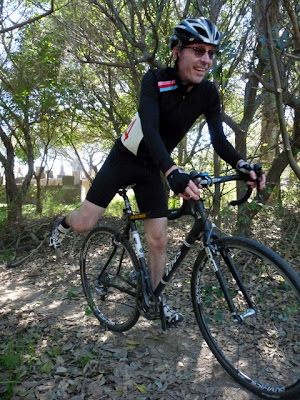
 Swamps to hurdle
 Or not
 Barriers to clear

 Or not

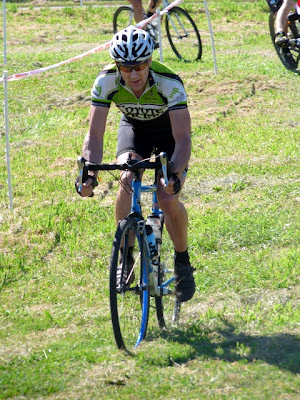

 The course was open to all at the start and I gave it a go on my yet-to-be-formally-introduced touring-bike, with panniers. After two trial laps I remembered why I didn't race Cx and preferred to spectate
 This guy agrees...

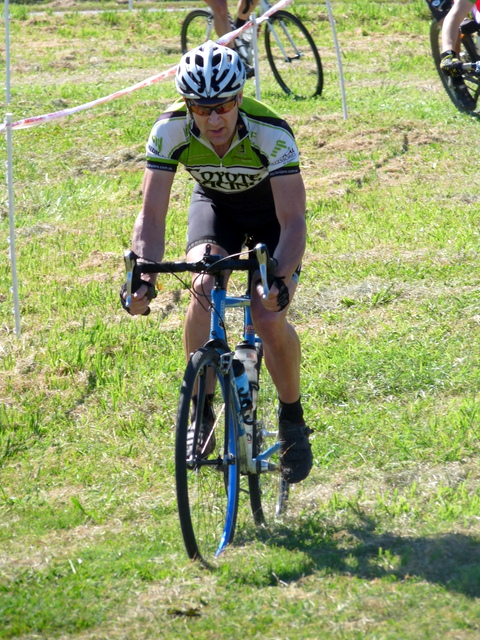
It was an interesting course, with off-camber grassy corners


And lots of hard pedalling over grass...


Friday, August 16, 2013
Mini Brew In A Bag
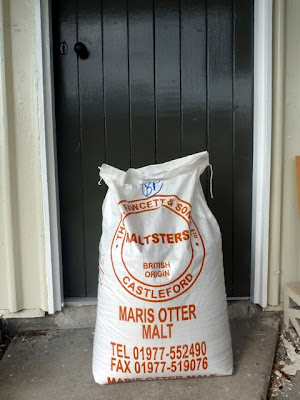
I was lucky enough to win a bag of grain at the recent homebrew conference, and it wasn't a small bag - just over 25kg, direct from West Yorkshire
 Normally I brew partial-mash beers, using dried malt extract to boost the strength of my beers so that I can produce 23+ litres of a reasonably (or even unreasonably) strong brew. But with so much grain to hand I had no excuse to not brew 'all grain', ie with all of the sugars coming from the grain itself.
The first issue was 'cracking' the grain - in other words taking the barley seeds and cracking them open by using my Corona hand mill . These are the seeds before they were milled
 and after 20 minutes or so of surprisingly easy grinding here's what's known as the 'grain-bill' - 2.75kg of cracked barley along with 1/2kg of munich malt and 1/4kg of cara-pils,
 I was limited by the size of my brew pot, a mere 19l which meant that I could only produce a half-batch of around 12 litres, but it gave me the chance to experiment without endangering huge quantities of grain or water. I was trying a style called 'Brew In A Bag', a relatively equipment-free way of brewing which coincidentally was developed in Australia in response to water shortages.
Once the grain was prepared I brought around 12l of water up to around 76 degrees C, lined the pot with a brew bag and tipped in the grain.
 After a decent stir I had a nice malty broth at around 65 degrees
 I left it for an hour or so at a constant temperature to let the enzymes in the malt break down the sugars - I used an old sleeping bag to help insulate the pot and lost around 3 degrees over that hour. This is traditionally the time where you 'relax and have a homebrew' but in my case I needed to have a late lunch and get a new gas bottle - preparation is everything.
 After the mash I drained the bag - it's good to see my old climbing gear still has a purpose
 and whilst it dripped I kneaded the bag to help pull out those lovely sugars. Silicon gloves helped kept my hands from being burnt
 and also helped with my Dr Zoidberg impression - *whooop whoop whoop whoop*
 Next came the controversial step - the 'sparge'. This is simply using additional water to help suck out more sugars from the grain, but it seems to be the basis of a lot of disagreement on the homebrew forums. I kept it simple and tried using 5l of room temperature water in an Esky. I dropped the bag in and give it a decent knead, then hoisted it from the skyhook again and let it drain.
 For homebrew nerds, I ended up with around 10litres of 1.058 gravity wort and the sparge gave 5 litres of 1.028 gravity wort. Mixed together they gave around 15l of 1.047 gravity wort, which needed to be bought to the boil.
The used grains ended up in the compost bin
 And the wort was put on the gas burner. Next time I'd use warmer sparge water and I'd kick off the boil of the original wort whilst I'm sparging, which would probably save me around half an hour.
 By this time a storm had rolled in and my burner had no windshield, so I couldn't just add hops at the appropriate times. I needed to stay outside and keep an eye on the pot for the full hour long boil. Me, an under-cover hammock, a cold beer, a spattering of rain, a hot fire and rolling steam - it was very meditative
 but sadly all things come to an end and after an hour it was time to cool the pot in a water bath
 My fermenter is still full of cider so I needed to make do with what I had to hand, but the 11 or so litres of 1.062 brew that I produced fitted nicely into a handy water container
 Our little family of fermentation is doing well
 and the new brew seemed to be flourishing - this is a day and a half later at an ambient temperature of around 16 C!

The first issue was 'cracking' the grain - in other words taking the barley seeds and cracking them open by using my Corona hand mill . These are the seeds before they were milled


Once the grain was prepared I brought around 12l of water up to around 76 degrees C, lined the pot with a brew bag and tipped in the grain.


The used grains ended up in the compost bin


I should end up with around 10 litres of almost 7% IPA - or I can dilute it a little once the initial fermentation dies down and get around 14 litres of a 6%ish brew. You the readers are also generally my beer tasting circle, so which would you prefer? Let me know what you think, and in a week or so I will follow up on the most popular suggestion...
Thursday, August 15, 2013
Hey Josie
A lovely local indie-jangle tune this week - Hey Josie by the Go Violets. Great video too, filmed not far from Brisbane and featuring a very hungry beagle (is there any other sort?).
For some reason I can't embed it, but follow the link for joyful goodness
For some reason I can't embed it, but follow the link for joyful goodness
Return to dirt
We had a day off yesterday for 'Ekka Day'. Theoretically it's a chance to visit the Brisbane country show, eat fried foods, pat cows, watch carnival sideshows and shuffle along with large crowds of people. But after visiting Ekka a few times over the years I thought that getting back out on the mountain bike would be a better use of my time. It's been around 6 months since my last foray onto dirt and it was great to be back in the bush - so many trails, so little time...


 There's are new trail being built in Daisy too - the lovely undulating rock-bearing Glider
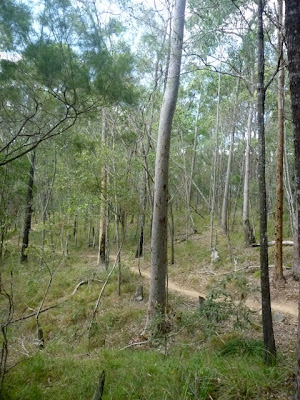

 I was out on the Clown Bike, which is a fun bike to ride but it was hard work on a singlespeed with flat pedals after so long away
 When can I go again?


Subscribe to:
Posts (Atom)